
 leerly.io
After a year living in Spain and immersing myself daily in Spanish lessons, I recognized a gap in how language learning tools helped people build genuine fluency. Drawing on the Comprehensible Input methodology popularized by Spanish-teaching YouTubers, in which students focus primarily on reading and listening to their target language, I co-founded leerly.io to build software that made this research-backed approach accessible and consistent for learners outside a classroom.
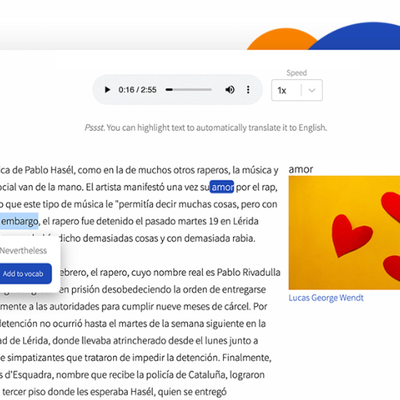
As founder and sole engineer, I built the entire platform while simultaneously managing two language teachers (Violeta and Ali) who wrote articles and recorded audio, and while coordinating with advisors and early-stage VCs alongside my co-founder Ulrik, who led business development. The core technical challenge wasn't algorithmic complexity but UX experimentation: syncing audio narration with word-by-word visual highlighting, embedding contextual imagery for vocabulary, and passively tracking each user's exposure to specific verb conjugations and vocabulary over time, all while sourcing and structuring a usable corpus of Spanish language data. Because comprehensible input intentionally exposes learners to material slightly above their level, I had to balance helpful cues against distraction, relying heavily on my own experience as the platform's ideal user to guide design decisions before testing with others.
Over roughly a year and a half of building this alongside full-time work, leerly.io grew to a few hundred users across free and paid tiers, reaching around $400 in monthly recurring revenue. This was enough at points to largely cover our writers' pay from article-based revenue alone. We landed our first paying customer, a milestone that made the business feel real, and saw unexpected organic traction internationally, with one of our teachers even being interviewed on Galician television about the platform. Many of our paying users turned out to be based in Europe rather than the U.S., a surprising signal about where interest was strongest.
Ultimately, we made the call to spin down the company after about two years, as scaling further would have required a full-time 50-hour-a-week commitment that wasn't viable given our day jobs. The timing also aligned with GPT-3's release, which was about to reshape the entire language-learning landscape anyway. We migrated all users to a free plan, and while the platform remains live, it's no longer actively maintained or monetized. The experience validated that the core product resonated with real users, even though we didn't operate long enough to fully separate high natural churn in language learning from our specific product decisions.
I love leerly, as it was my first failed business, which is a badge I carry with pride. And it will always remind me of my time living in Spain and the friends I made there.