 Mint Finance
During my quant research internship at Mint Finance, I chose the Nasdaq-100 index enhancement track out of three fixed project options offered in week one. The mandate was explicit: build something that beats QQQ, prove the edge isn't just repackaged beta, and back every claim with 8-10 years of history. Beyond that starting brief, the actual mechanism was mine to design.
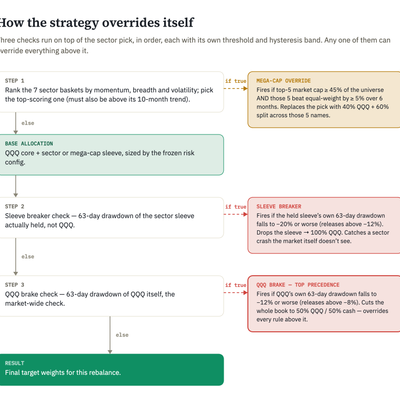
I built a strategy that rotates a QQQ core into whichever Nasdaq-100 sector shows the strongest momentum, with two custom safety layers on top. A mega-cap override checks at every rebalance whether the top 5 stocks by market cap (deduplicated across dual-class shares like GOOG/GOOGL) already make up 45% or more of the cap-weighted universe and have beaten the equal-weighted index by 5% or more over the trailing 6 months — if both hold, the strategy stops ranking sectors and shifts to 40% QQQ plus 60% split across those five names directly. I also added two independent drawdown brakes: one watches QQQ's own trailing 63-day drawdown and cuts the book to 50% QQQ / 50% cash if it falls past -12% (releasing above -8% to avoid flapping), while a second watches the currently-held sector sleeve on the same logic and drops to 100% QQQ if that sleeve alone craters past -20%, since a single sector can collapse while the broader market is fine. I validated the whole system with a leak-free nested walk-forward test spanning 22 years, well beyond the 8-10 year minimum, plus separate parameter sensitivity and trading-cost analysis.
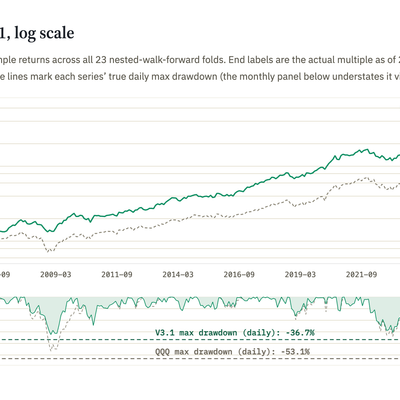
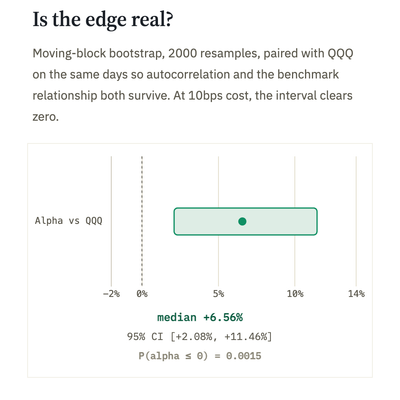
After validation, the strategy earns about 6.3% annualized alpha over QQQ net of trading costs, with a higher Sharpe ratio (1.04 vs 0.73) and a smaller max drawdown (-37% vs -53%). It's now running on a dedicated live paper-trading account at Mint, separated from other interns' strategies so the risk brakes don't interfere with each other. I also prepared the research report, notebook, and one-page strategy card required for the program's Final Pitch, where external judges from hedge funds, investment-bank research desks, and wealth management firms evaluate the work and can extend referrals or direct hires.