An earlier project of mine failed to find a working timing signal for US Treasury yields. I pre-registered 66 tests, locked the held-out window in code, and none passed. One signal looked strong at first (t = −4.62), but that came from overlapping returns. After correcting for serial correlation (Newey-West), it fell to −0.76. That failure taught me two things: lock tests before looking, and timing a single bond gives too few independent bets. So I redesigned the question.
The question. Carry is one of the best-documented premiums in finance. Koijen, Moskowitz, Pedersen and Vrugt (2018) find it across asset classes, including government bonds. I tested whether Treasury carry across the yield curve is a real premium or just rate exposure under another name.
The setup. I built monthly returns for the curve from the Fed's zero-coupon yields (Gürkaynak-Sack-Wright). I wrote down every test and pass/fail bar and tagged them in git before running anything. The 2019–2026 window stayed locked in code until a one-time reveal, and every data access was logged.
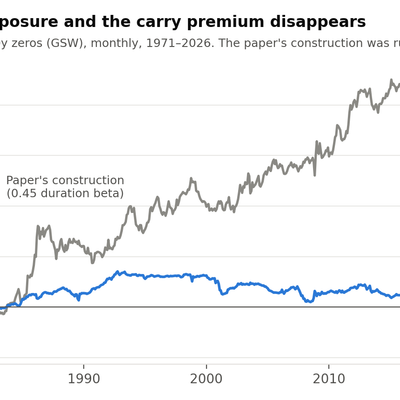
Replication first. The paper's construction replicated on my data: Sharpe 0.28 before costs, against their 0.33. It also carried a duration beta of 0.45, meaning a large share of the return came from simply being long bonds.
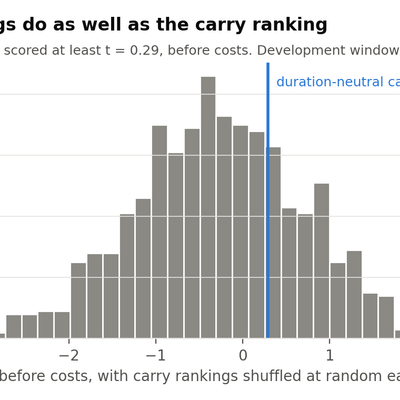
A design flaw, caught before the reveal. My first rate-neutral version ranked bonds on carry per dollar but held them in DV01-neutral (rate-neutral) sizes, so the ranking and the positions were in different units. I caught this in a pre-registered diagnostic, amended the design to rank on carry per unit of duration, recorded the change, and only then continued.