
I'm currently a marketing team of one, and not a writer by trade. But I run marketing for a pre-seed startup, so I need to be writing. So this was the perfect time to test how AI can improve my content planning and efficiency. I built a content brief skill and scheduled prompt that lands in my inbox every Monday and Thursday at 8:07am. It pulls out the best ideas and themes from both the larger ecosystem and from within Trove's own channels. The workflow isn't overly complex. It scans my own meeting transcripts, Slack, Notion, and Gmail for thematic patterns in parallel with public news, LinkedIn, and X. It flags the moments where a recurring internal theme is converging with a public trend. Those convergences are the trends worth writing into this week.
The workflow
Internal: meeting transcripts, Slack, Notion, Gmail from the last 7 to 14 days, read for thematic patterns.
External: news, LinkedIn, X over the same window.
Cross-reference: for every external trend, is this a theme that's been recurring internally?
When the two layers converge, that's the strongest signal. Before any of this, the skill runs a saturation check against my last 14 days of posts so it doesn't keep handing me the same hook. And before any trend makes it into the brief, the skill has to be able to articulate the angle cleanly. If it can't, the trend gets dropped. (Full sanitized skill file linked at the bottom. Fork it, swap in your themes, point it at your own sources.)
A sample brief
Sanitized excerpt from a recent Monday morning.
Saturation · "career capital" fresh, last covered 24 days ago · "good friction" saturated, 3 posts in 14 days.
Signal 1 - High-priority convergence Trend: Public coverage on AI-generated work samples in job applications is intensifying this week, with several major outlets framing it as a screening problem.
Angle: Screening is the wrong lens. The category needs better signal, not better filters. Recurrence: This theme has appeared in 5 internal touch points over the last 14 days, intensifying. Sharp line from a customer call worth surfacing: "We keep buying better filters; what we actually need is work that can't be faked." [PERMISSION NEEDED -- customer call, May 22]
Format: LinkedIn post · this week
Theme: AI & trust (fresh)
It should go without saying, but I'll say it anyway: anything with a quote needs permission before publishing. The skill flags every quote attributable to a real person, customer, partner, investor, teammate, with a "needs permission" tag. The brief is a draft for me. Anything that leaves the brief and lands in a post under an attributed name needs an explicit yes from that person first. A lot of AI content tooling treats source material as fair game by default, and a workflow built that way would be its own kind of joke for a company in the verification business. The scheduled layer: One-off prompts add more work and noise and that's a no go for me. For something to add continuous value, it needs to be scheduled. Mine runs every Monday and Thursday. The brief lands while I'm dropping my daughter at school. The other big benefit of scheduling: the prompt runs against your own data on a cadence, remembers what you've already covered, and surfaces converging trends. The outcomes here are still evolving, but the workflow has let me be faster to produce and publish, and has freed up hours per week. To be clear: this is not meant to read as "this skill replaces content teams," because it doesn't. I cannot wait to be able to hire a content team. It has helped me be a more focused and opportunistic writer.
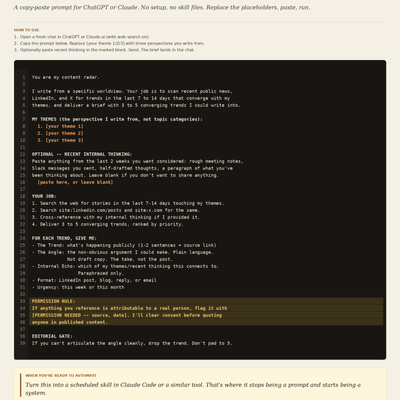
Supporting materials: full sanitized skill file & fillable prompt for any AI chat
 Trove
Trove