

In the summer of 2024 I was invited to Strange Ventures' inaugural Design Fellowship, a four-week sprint applying ArchetypeAI's NEWTON multi-modal foundation model (a Strange portfolio company in physical AI) to a real industry problem. Healthcare emerged as one of the most promising domains, and [a large international pharmaceutical company] came in as the client. We organized as a three-person team, with me leading research and strategy alongside Greg McNamara (industrial design / CMF) and Qiyu Hu (HCI, UX research).
We focused on our client's in vitro diagnostics, specifically the pre-analytical phase: the stretch from a patient's blood draw through transit to the lab. Preexisting research from the client identified this as the part of the diagnostic chain where 62% of sample errors actually occur, including tube-filling errors, patient-ID mismatches, and temperature excursions. The strategic application of AI within this journey remained undefined.
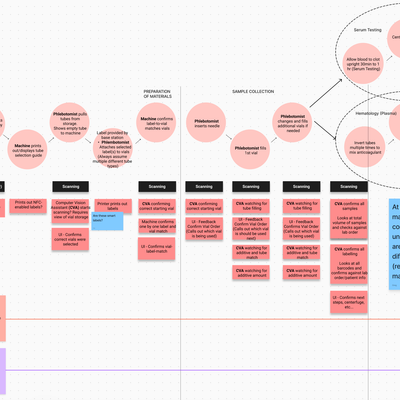
I led the work of mapping specific AI capabilities to those known errors, focusing on grounded, commercially viable applications rather than speculative ones: matching what the technology could reliably do today to the failures that mattered most. We developed two separate but connected design concepts ("Somanion"), framed as a roadmap toward a north-star vision of decentralized, real-time-monitored diagnostics.
The first was a smart transit system: a tracker that rides with the sample, fusing GPS, temperature, motion, and other sensor inputs to give labs continuous real-time visibility.
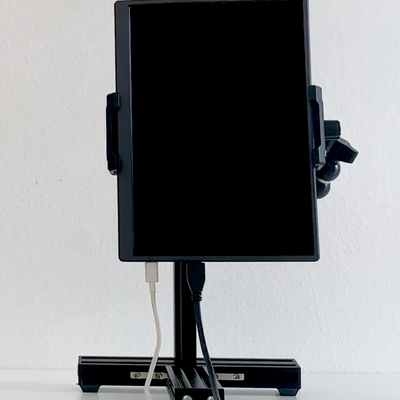
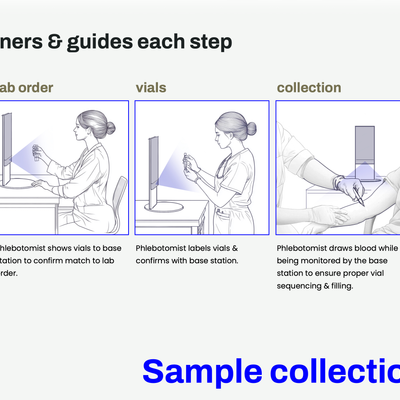
The second was a desktop base station for sample collection: a peripheral that uses computer vision and multimodal sensing to assist phlebotomists in real time, confirming patient ID and validating tube type. Quiet, supportive automation against a protocol that's complicated and unforgiving.
My role as research and strategy lead spanned client stakeholder engagement, opportunity definition, and concept framing. My biggest contribution was taking the client's identified benefits for phlebotomist users (improving accuracy and supporting them through a complicated protocol) and extending that thinking to surface a new value for the patient. I recognized that, for the first time in diagnostic history, these sensing capabilities would enable patients to have transparency into the analysis of their own sample. The same way someone tracks a package, empowering the transport containers with real-time sensing gives patients updates on when their doctors receive results, providing deeper reassurance and peace of mind. That insight reframed the work with the client, moving the concepts from operational improvement into something that mattered directly to future patients.
The four-week constraint forced a sharpness that bypassed meandering. Staying in close proximity to the Archetype team kept the strategy grounded in technical reality rather than speculative aspiration. Ultimately, this work was used to validate the client's R&D direction and greenlight further exploration into decentralized diagnostics.
 Strange Ventures